

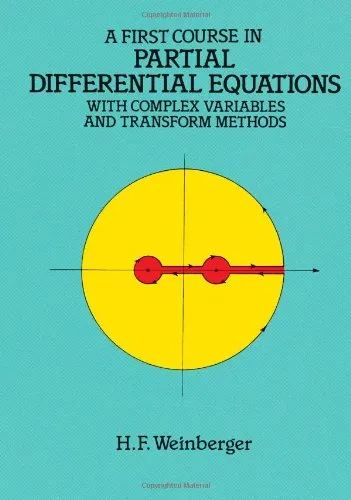
Book guide and evaluation
A First Course in Partial Differential Equations: with Complex Variables and Transform Methods
H. F. Weinberger
English
Beginner
Mathematical Analysis
4.5 / 5
0 reviews
1995
Published
456
pages
543
views
Welcome to an engaging journey into the rich and challenging world of partial differential equations (PDEs) with "A First Course in Partial Differential Equations: with Complex Variables and Transform Methods". Written to serve both as an introductory text and a profo
Before you read
What will you get from this book?
Welcome to an engaging journey into the rich and challenging world of partial differential equations (PDEs) with "A First Course in Partial Differential Equations: with Complex Variables and Transform Methods". Written to serve both as an introductory text and a profound reference guide, this book is meticulously designed to unravel the complexities of PDEs using the dynamic interplay of complex variables and transform methods.
Detailed Summary of the Book
"A First Course in Partial Differential Equations" masterfully integrates theoretical concepts with practical applications to provide a comprehensive foundation in the subject. The narrative begins with a systematic exploration of PDEs, introducing their derivations and types, and moves on to fundamental topics like boundary value problems. The book skillfully employs complex variables to simplify PDE solutions, highlighting the elegance and power of this mathematical technique. Transform methods, another crucial component of this text, are introduced in a step-by-step manner to solve boundary and initial value problems, emphasizing systematic approaches like the Fourier and Laplace transforms. This book is not just confined to theoretical expositions; it also deeply engages with the practical realm, using applications from physics and engineering to illuminate abstract concepts. By focusing on examples and detailed problem sets, the reader is equipped with the necessary tools to tackle more advanced studies and real-world problems in the field of PDEs.
Key Takeaways
- Comprehensive introduction to partial differential equations, ideal for beginners.
- In-depth exploration of complex variables and transform methods in solving PDEs.
- Integration of theory with practical applications in physics and engineering.
- Step-by-step guidance on solving boundary and initial value problems with transformative approaches.
- Extensive problem sets designed to enhance understanding and application of concepts.
Famous Quotes from the Book
“Partial differential equations are the mathematical arteries that channel the flow of physical truths.”
“In the world of PDEs, complex variables transform the overwhelming into the manageable, turning chaos into clarity.”
Why This Book Matters
This book stands out as an essential resource for those embarking on the study of partial differential equations, not only because of its clarity and depth but also due to its effective pedagogical approach. "A First Course in Partial Differential Equations" bridges the gap between undergraduate mathematics and applied scientific and engineering challenges, making it an invaluable asset for students and professionals alike. By utilising complex variables and transform methods, it offers a unique perspective that enriches the reader's problem-solving arsenal. Furthermore, the book’s emphasis on practical application ensures that readers can effectively translate theoretical insights into tangible outcomes. This makes it a critical tool for anyone looking to excel in science and engineering fields where PDEs play a pivotal role.
Ask this book
Your question is answered in the context of this title and author. Each answer uses 2 points.
Sign in to ask the book assistant.
Reader reviews
0 reviews, 4.5 average out of 5
No reviews yet
If you have read this book, help the next reader with your experience.
Write a review
Sign in to publish a review.
Reader questions and answers
Ask a focused question and learn from the community.
Sign in to ask or answer a question.
No questions yet
Be the first to ask a clear, useful question.
What to read next
Related references that continue this learning path.
Functional Equations and Inequalities: Solutions and Stability Results
K Ravi;B V Senthil Kumar;John Michael Rassias
2017
View book
Partial Differential Equations: An Introduction to a General Theory of Linear Boundary Value Problems
Aleksei A. Dezin (auth.)
1987
View book
Elliptic Partial Differential Equations of Second Order
David Gilbarg,Neil S. Trudinger
2001
View book