

Book guide and evaluation
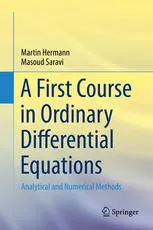
A First Course in Ordinary Differential Equations: Analytical and Numerical Methods
Martin Hermann,Masoud Saravi (auth.)
English
Beginner
Mathematics
4.3 / 5
0 reviews
2014
Published
300
pages
202
views
Introduction to "A First Course in Ordinary Differential Equations: Analytical and Numerical Methods" Differential equations are a cornerstone of applied mathematics, providing the foundation for modeling and solving real-world phenomena across physics, biology, engineer
Before you read
What will you get from this book?
Introduction to "A First Course in Ordinary Differential Equations: Analytical and Numerical Methods"
Differential equations are a cornerstone of applied mathematics, providing the foundation for modeling and solving real-world phenomena across physics, biology, engineering, and countless other scientific fields. "A First Course in Ordinary Differential Equations: Analytical and Numerical Methods" serves as a comprehensive and accessible introduction to the subject, aimed at students, educators, and professionals seeking to gain a solid understanding of ordinary differential equations (ODEs).
This book is designed to bridge the gap between theory and practical application, making it an ideal resource for beginners while remaining a valuable reference for those already familiar with the topic. With a dual focus on analytical methods and numerical techniques, the authors, Martin Hermann and Masoud Saravi, guide the reader through key concepts and problem-solving approaches in a structured and engaging way.
Detailed Summary of the Book
The book spans an interconnected exploration of ordinary differential equations, systematically unraveling their significance, methods of solving them, and their applications in the real world.
The early chapters lay a robust foundation by covering the basic concepts of ODEs, such as separable equations, first-order linear equations, and exact differential equations. These chapters equip readers with the tools required to tackle fundamental problems, while also emphasizing precision and clarity in mathematical derivations.
As the book progresses, it delves deeper into more complex topics, including second-order and higher-order differential equations, the method of undetermined coefficients, and variation of parameters. Readers are gradually introduced to challenges like solving systems of ODEs, stability analysis, and understanding asymptotic behavior.
One distinctive feature of this book is its balanced approach to analytical and numerical methods. The authors devote significant attention to topics like Euler's method, Runge-Kutta methods, and error analysis for numerical solutions. These chapters provide step-by-step guidance and include examples to ensure practical understanding.
Furthermore, the book illustrates how ODEs apply to real-world problems, such as population dynamics, electrical circuits, and mechanical vibrations. By integrating theory with applications, the authors effectively demonstrate the relevance of differential equations in everyday life.
Key Takeaways
- An intuitive introduction to the basic concepts and classifications of ordinary differential equations.
- Step-by-step demonstrations of analytical solution methods and their conditions of applicability.
- A comprehensive exploration of numerical methods, including detailed error analysis for practical computations.
- Real-world applications that bridge abstract mathematics with practical utility.
- Ample examples, figures, and exercises that support self-study and reinforce understanding.
Readers will gain not only theoretical knowledge but also hands-on experience with numerical simulations, enabling them to tackle increasingly complex differential equations in both academic and professional settings.
Famous Quotes from the Book
"The joy of mastering ordinary differential equations lies not only in understanding their structure, but in witnessing how they bring a mathematical lens to the tapestry of physical reality."
"Analytical methods are like microscopic lenses; they provide clarity, precision, and insight into exact solutions. Numerical methods, on the other hand, offer a macroscopic approach, painting a broader, computationally feasible picture of real-world dynamics."
Why This Book Matters
What sets this book apart is its dual emphasis on accessibility and depth. Written with clarity and precision, it aims to demystify one of the most important areas of applied mathematics.
For students, this book provides a stepping stone into the mathematically rich world of ordinary differential equations, helping them build confidence through foundational concepts, challenging exercises, and illustrative examples. Educators will find it a valuable teaching tool, with a focus on both traditionally taught techniques and computational methods suited to the modern era of technology.
In the scientific and engineering disciplines, differential equations are indispensable tools. This book equips future professionals and researchers with the problem-solving capabilities to model, analyze, and innovate in their respective fields. By blending analytical rigor with computational practicality, it prepares readers to meet the challenges of complex systems involving change and dynamics.
Ask this book
Your question is answered in the context of this title and author. Each answer uses 2 points.
Sign in to ask the book assistant.
Reader reviews
0 reviews, 4.3 average out of 5
No reviews yet
If you have read this book, help the next reader with your experience.
Write a review
Sign in to publish a review.
Reader questions and answers
Ask a focused question and learn from the community.
Sign in to ask or answer a question.
No questions yet
Be the first to ask a clear, useful question.
What to read next
Related references that continue this learning path.


Modern Computer Vision with PyTorch: A Practical Roadmap From Deep Learning Fundamentals to Advanced Applications and Generative AI, 2nd Edition
V Kishore Ayyadevara,Yeshwanth Reddy
2023
View book