Graph Theory, Proceedings of the Conference on Graph Theory, Cambridge
Béla Bollobás (Eds.)
1982
View book
Book guide and evaluation
Sebastian M. Cioabă,M. Ram Murty (auth.)
0 reviews
Published
pages
views
Introduction to 'A First Course in Graph Theory and Combinatorics' Graph Theory and Combinatorics are vibrant fields of mathematics that offer deep insights into structures familiar to both theoretical and applied sciences. 'A First Course in Graph Theory and Combinatorics' pr
Before you read
Graph Theory and Combinatorics are vibrant fields of mathematics that offer deep insights into structures familiar to both theoretical and applied sciences. 'A First Course in Graph Theory and Combinatorics' provides a robust introduction to these disciplines, ideally suited for undergraduate students embarking on their mathematical journey.
This book serves as an entry point to the world of Graph Theory and Combinatorics, orchestrated with careful attention to pedagogy and exploratory learning. Covering the essentials from fundamental concepts to advanced topics, it begins with definitions and examples that are approachable for someone new to the subject. Topics such as Eulerian circuits, Hamiltonian cycles, and planar graphs are explored in detail.
The section on Combinatorics introduces readers to permutations, combinations, and the principle of inclusion-exclusion. Various counting techniques and their applications are explained through motivating examples and rigorous proofs. The text also delves into generating functions and Ramsey theory, promising a comprehensive view of these essential combinatorial tools.
Mathematical rigor is matched with clarity through numerous exercises that challenge students to deepen their understanding. Ample problems range from basic to thought-provoking, making them suitable for guided learning or independent study.
"Mathematics is not about numbers, equations, computations, or algorithms: it is about understanding."
"In every way, a solution to a problem reveals deeper pathways to pursue, illuminating the vast landscape that is the mathematics of relations."
This book is a stepping stone into the intricate yet fascinating world of Graph Theory and Combinatorics, laying a foundation that is crucial for advanced study in computer science, operations research, and beyond. By enabling students to grasp both intuitive insights and technical skills, it fosters a deeper appreciation of how these concepts manifest in everyday problems.
Its structured presentation invites learners to explore the bridge between pure mathematics and its tangible applications, making complex theories accessible and relevant. Readers are encouraged to see beyond the surface, to contemplate the interconnectedness of graphs and combinatorial principles in nature, technology, and social structures.
Your question is answered in the context of this title and author. Each answer uses 2 points.
0 reviews, 4.5 average out of 5
Sign in to publish a review.
Ask a focused question and learn from the community.
Related references that continue this learning path.
Béla Bollobás (Eds.)
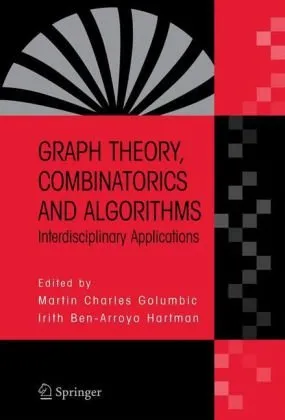
Martin Charles Golumbic,Irith Ben-Arroyo Hartman