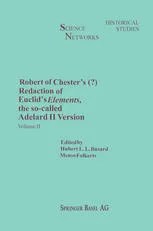
Robert of Chester’s (?) Redaction of Euclid’s Elements, the so-called Adelard II Version: Volume II
Dr. Hubert L. L. Busard,Prof. Dr. Menso Folkerts (auth.)
1992
View book
Book guide and evaluation
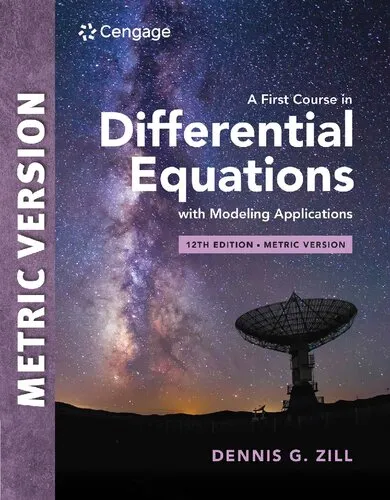
Dennis Zill Roberto Martinez
0 reviews
Published
pages
views
Introduction to "A First Course in Differential Equations with Modeling Applications Solutions Manual, 11th Edition" Welcome to the solutions manual for "A First Course in Differential Equations with Modeling Applications," 11th Edition. This book serves as an essential
Before you read
Welcome to the solutions manual for "A First Course in Differential Equations with Modeling Applications," 11th Edition. This book serves as an essential companion to the primary textbook authored by Dennis G. Zill, laying a strong foundation for learners seeking to expand their understanding of differential equations and their applications. Designed with clarity, precision, and practicality in mind, this manual offers comprehensive, step-by-step solutions to all exercises from the main textbook. It is ideal for students, educators, and professionals aiming to deepen their grasp of calculus, modeling, and differential equations in applied mathematics and the sciences.
By addressing a variety of solution techniques, theoretical concepts, and real-world examples, the solutions manual bridges the gap between understanding the principles of differential equations and mastering their applications in various fields. Whether you're delving into linear, nonlinear, or partial differential equations, this manual empowers learners to approach problems systematically and confidently.
This solutions manual provides detailed solutions to the problems presented in the textbook's 11th edition. Organized to follow the textbook's chapters, each section corresponds to concepts introduced in the primary book, including topics such as first-order differential equations, higher-order linear differential equations, systems of differential equations, Laplace transforms, series solutions, and boundary value problems. By thoroughly explaining procedures, the manual supports students in developing a deeper conceptual understanding of each problem type, fostering not only technical proficiency but also problem-solving intuition.
The manual emphasizes step-by-step methods and clear justifications for each mathematical operation. It is especially suitable for self-learners or students preparing for exams, as it focuses on building confidence while tackling differential equations systematically. The breadth of application-based examples, such as mechanical vibrations, population dynamics, and circuit analysis, provides practical insight into how differential equations shape engineering, physics, biology, and other sciences.
With consistent formatting, logical structure, and user-friendly explanations, this solutions manual ensures that all students, regardless of their background, can carefully navigate through even the most challenging problems in the textbook.
"The study of differential equations is not just about solving equations; it is a key to unlocking the mysteries of the dynamic world around us."
"Mathematics provides the language of science, and differential equations are at the heart of its grammar."
"The process of solving differential equations mirrors the scientific journey: observation, formulation, calculation, and validation."
Differential equations serve as the cornerstone of modern science and engineering, describing phenomena ranging from the motion of planets to the dynamics of ecosystems, electrical circuits, and even economic trends. The solutions manual for "A First Course in Differential Equations with Modeling Applications, 11th Edition" provides an invaluable guide to mastering the essentials of this critical subject.
This book goes beyond merely providing answers—it equips learners with problem-solving techniques, analytical reasoning skills, and the ability to model complex systems mathematically. Its clear, step-by-step solutions and real-world relevance make differential equations accessible to students of varying levels of expertise. Moreover, it instills the confidence needed to tackle increasingly complex challenges in advanced courses and professional applications.
By serving as both a guide and a resource for deeper learning, this manual plays an indispensable role in shaping the future of engineers, physicists, mathematicians, and professionals across diverse disciplines.
Your question is answered in the context of this title and author. Each answer uses 2 points.
0 reviews, 4.7 average out of 5
Sign in to publish a review.
Ask a focused question and learn from the community.
Related references that continue this learning path.
Dr. Hubert L. L. Busard,Prof. Dr. Menso Folkerts (auth.)