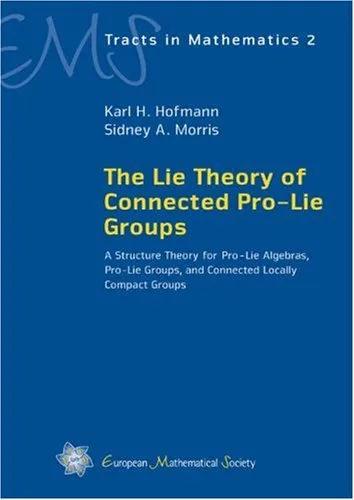
The Lie Theory of Connected Pro-Lie Groups: A Structure Theory for Pro-Lie Algebras, Pro-Lie Groups, and Connected Locally Compact Groups
Karl H. HofmannandSidney A. Morris
2007
View book
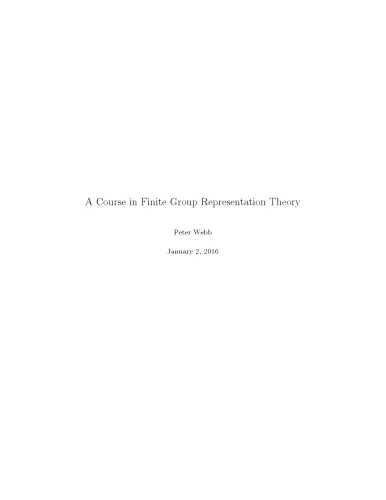
Book guide and evaluation
Peter Webb
0 reviews
Published
pages
views
Introduction Welcome to 'A Course in Finite Group Representation Theory'. This book is a comprehensive journey into the fascinating world of finite group representations, distilled into a structured and accessible format for students, academics, and enthusiasts alike. It
Before you read
Welcome to 'A Course in Finite Group Representation Theory'. This book is a comprehensive journey into the fascinating world of finite group representations, distilled into a structured and accessible format for students, academics, and enthusiasts alike. It aims to build a solid foundation in the theoretical principles while connecting these ideas to practical applications in diverse fields. With a focus on clarity, each concept is elucidated with precision and backed by examples to enhance understanding and retention.
The study of finite group representation theory serves as a bridge between abstract algebra and practical applications in quantum mechanics, chemistry, and coding theory, just to name a few. This book deeply examines the representation of groups, especially finite groups, over fields such as the field of complex numbers. Beginning with an introduction to group theory fundamentals, the narrative delves into the concept of linear representations where groups are perceived as linear transformations of vector spaces.
In subsequent chapters, you will explore the core concepts of character theory, module theory, and the significance of irreducible representations. The book also offers a unique perspective on how group actions facilitate symmetry descriptions in various contexts, thus making theoretical insights applicable. Advanced topics cover the intricacies of induced representations and Frobenius reciprocities, with detailed discussions that encourage self-exploration and further research.
To enhance practical understanding, each chapter includes exercises ranging from basic to challenging problems, allowing you to test your grasp of the material. By the end, you'll not only have learned about finite group representations but will also have a toolkit of methods and approaches to apply this knowledge effectively.
"To understand the universe of mathematical symmetry is to grasp the language of representation theory."
"In every group action, there lies a story of transformation that representation theory unveils."
In the realm of advanced mathematics, representation theory of finite groups is a cornerstone that supports and enriches many other topics in both pure and applied mathematics. This book matters because it elevates the understanding and appreciation of the intricate connections between abstract algebraic structures and their operational roles in the real world. It is crafted to be a resource that not only informs but inspires. Those who invest time in these pages will find themselves equipped to venture into complex topics with confidence and curiosity.
Your question is answered in the context of this title and author. Each answer uses 2 points.
0 reviews, 4.4 average out of 5
Sign in to publish a review.
Ask a focused question and learn from the community.
Related references that continue this learning path.
Karl H. HofmannandSidney A. Morris