
Book guide and evaluation
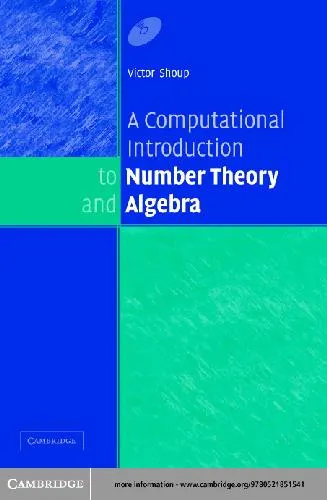
A Computational Introduction to Number Theory and Algebra
Victor Shoup
English
Beginner
Software Engineering
4.6 / 5
0 reviews
2005
Published
533
pages
132
views
Welcome to the introduction to A Computational Introduction to Number Theory and Algebra, a book that bridges the gap between theoretical mathematics and practical computational applications. Written by Victor Shoup, this masterpiece is designed to cater to readers with a r
Before you read
What will you get from this book?
Welcome to the introduction to A Computational Introduction to Number Theory and Algebra, a book that bridges the gap between theoretical mathematics and practical computational applications. Written by Victor Shoup, this masterpiece is designed to cater to readers with a range of mathematical backgrounds, from curious beginners to advanced academics. Through a strong emphasis on clarity, rigor, and relevance, this book lays the foundation for modern cryptographic systems and computational algebraic techniques. Let’s dive into its detailed summary, key takeaways, notable quotes, and understand why this book remains a cornerstone in computational mathematics.
Detailed Summary of the Book
A Computational Introduction to Number Theory and Algebra is a comprehensive, self-contained guide that explores a rich collection of topics at the intersection of number theory, algebra, and their computational counterparts. The book is particularly focused on explaining the mathematical foundations necessary for cryptography, computational algorithms, and theoretical computer science. Through a modern perspective, it presents concepts in an engaging yet rigorous way, ensuring both theoretical depth and practical understanding.
The book begins with basic number theory, exploring concepts such as divisibility, prime numbers, and modular arithmetic. It then transitions into algorithmic topics like Euclid's algorithm, modular exponentiation, and primality testing, which are particularly important for cryptographic applications. Building on this foundation, the book moves into advanced algebraic structures, such as groups, rings, and fields, discussing their roles in both abstract mathematics and computational contexts.
One of the most remarkable aspects of the book is its emphasis on algorithms. Each chapter introduces essential algorithms for solving problems and provides detailed analyses of their efficiency and complexity. Readers are equipped not only with theoretical knowledge but also with the tools needed to implement solutions in practice.
The later chapters delve into advanced topics like elliptic curves, lattice-based techniques, and polynomial factorization, setting the stage for applications in modern cryptosystems. With exercises and problems integrated throughout each chapter, readers are encouraged to challenge their understanding and solidify their grasp of the material. This combination of theory, computation, and application makes the book indispensable for anyone interested in the intersection of mathematics and computer science.
Key Takeaways
- A solid foundation: Master the fundamental concepts of number theory and algebra with a focus on computational methods.
- Algorithmic approach: Learn key algorithms and their applications in encryption, primality testing, and integer factorization.
- Cryptographic insights: Understand the mathematical structures underpinning modern cryptographic systems such as RSA and elliptic curve cryptography.
- Problem-solving skills: Develop a problem-solving mindset by tackling challenging exercises and exploring detailed proofs.
- Self-contained learning: The book provides clear explanations, allowing readers to study independently without extensive prerequisites.
Famous Quotes from the Book
"Mathematics is not just about abstract structures and logical reasoning; it is also about solving real-world problems and understanding the algorithms that power modern technology."
"An elementary operation on integers might seem trivial at first glance, but its efficient implementation is the foundation of modern cryptography and computational number theory."
"Algorithms are not merely tools to compute; they are windows into the complexity of mathematical problems."
Why This Book Matters
A Computational Introduction to Number Theory and Algebra stands out for its ability to make a traditionally abstract field of mathematics approachable and practical. As the digital age continues to evolve, the book’s subject matter becomes even more relevant, emphasizing the profound connections between mathematics, cryptography, and computer science.
For educators and students alike, this book provides a rigorous yet accessible pathway to mastering topics critical to both advanced research and real-world applications. The emphasis on computational aspects transforms mathematics from theoretical abstraction into actionable knowledge, enabling readers to develop cryptographic systems, improve algorithms, and explore new frontiers in computer science.
In addition, the author’s clear and concise writing style, combined with a progression from basics to advanced topics, ensures that readers are not overwhelmed. Researchers, cryptographers, and engineers alike have praised this book for its balance of theory and practice. In a world increasingly reliant on digital security, this text serves as an essential resource for understanding the mathematics behind the technology.
Ask this book
Your question is answered in the context of this title and author. Each answer uses 2 points.
Sign in to ask the book assistant.
Reader reviews
0 reviews, 4.6 average out of 5
No reviews yet
If you have read this book, help the next reader with your experience.
Write a review
Sign in to publish a review.
Reader questions and answers
Ask a focused question and learn from the community.
Sign in to ask or answer a question.
No questions yet
Be the first to ask a clear, useful question.
What to read next
Related references that continue this learning path.

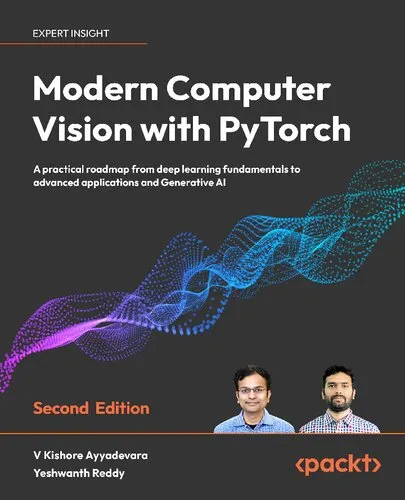
Modern Computer Vision with PyTorch: A Practical Roadmap From Deep Learning Fundamentals to Advanced Applications and Generative AI, 2nd Edition
V Kishore Ayyadevara,Yeshwanth Reddy
2023
View book