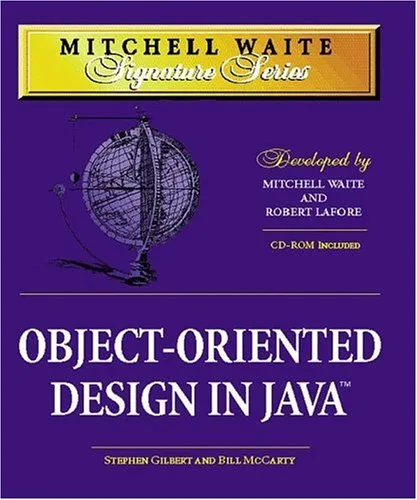
Mitchell Waite Signature Series: Object-Oriented Design in Java
Bill Mccarty,Stephen Gilbert
1998
View book
Book guide and evaluation
C. Thomas Wu
0 reviews
Published
pages
views
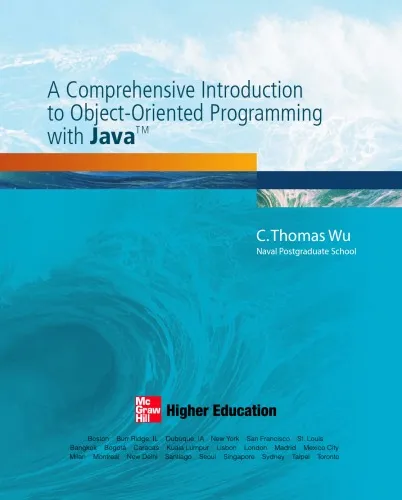
Introduction to "A Comprehensive Introduction to Object-Oriented Programming with Java, 1st Edition" Written by C. Thomas Wu, this book serves as an authoritative guide for students, educators, and enthusiasts who wish to master object-oriented programming (OOP) principl
Before you read
Written by C. Thomas Wu, this book serves as an authoritative guide for students, educators, and enthusiasts who wish to master object-oriented programming (OOP) principles using Java. As the cornerstone of modern software development, OOP principles enable programmers to build scalable, reusable, and efficient software systems. Designed for both beginners and those with some prior experience in programming, the book breaks down complex concepts into manageable, digestible chunks, making it an ideal resource for gradual learning.
The 1st Edition of "A Comprehensive Introduction to Object-Oriented Programming with Java" adopts a hands-on approach with real-world examples and intuitive explanations. Readers can expect a thorough treatment of topics like classes, objects, inheritance, polymorphism, encapsulation, and abstraction, paired with meticulous instructions on Java’s syntax and features. This book is not just about learning Java; it’s about understanding problem-solving from an object-oriented perspective.
Divided into carefully structured chapters, the book starts by introducing programming fundamentals and progresses seamlessly into advanced object-oriented concepts. The early chapters focus on Java basics, such as variables, data types, operators, and control structures. This foundation is necessary for understanding how Java integrates the principles of OOP.
Gradually, the book transitions to core OOP paradigms. Key areas such as class definitions, constructors, methods, inheritance structures, and polymorphic behavior are explored extensively. Special emphasis is placed on the importance of encapsulation, ensuring that Java developers understand how to write clean and secure code.
Later in the book, advanced topics are introduced, such as exception handling, file input/output (I/O), graphical user interfaces (GUI) using Swing, and multithreading. Each chapter is accompanied by programming examples, exercises, and challenges to reinforce the concepts presented. The text builds on best practices, introducing software engineering principles such as modular code design and object-oriented analysis and design (OOAD).
By the end, readers will have gained practical skills in Java programming and a deep understanding of OOP concepts, preparing them for real-world applications and further studies in software engineering or computer science.
"Object-Oriented Programming isn’t merely a technique—it’s a mindset that bridges the gap between real-world problem-solving and computational thinking."
"Java brings together simplicity and powerful abstraction, making it an ideal language for learning object-oriented design."
"A Comprehensive Introduction to Object-Oriented Programming with Java" is not just a textbook—it is a comprehensive learning companion. In the fast-moving tech industry, mastering OOP principles is fundamental for developing robust and maintainable software. C. Thomas Wu’s clear, structured approach to teaching makes even the most intricate of concepts accessible and understandable.
Unlike other programming books that focus solely on coding, this book emphasizes the philosophy and methodology behind OOP, encouraging readers to think in terms of objects, responsibility, and collaboration. With this critical mindset, developers can tackle software development challenges with confidence.
Additionally, Java remains one of the most widely used programming languages globally due to its platform-independence and powerful libraries. By focusing on Java, this book not only helps new programmers learn one of the most versatile languages but also sets them up for success in academic research, industry projects, and open-source contributions.
Whether you’re a student starting your programming journey, a self-taught developer seeking a more structured understanding, or an instructor looking for a dependable teaching resource, this book provides everything needed to master object-oriented programming and Java development.
"A Comprehensive Introduction to Object-Oriented Programming with Java" is the foundation for building a successful programming career or advancing into specialized areas of software engineering.
Your question is answered in the context of this title and author. Each answer uses 2 points.
0 reviews, 4.4 average out of 5
Sign in to publish a review.
Ask a focused question and learn from the community.
Related references that continue this learning path.
Bill Mccarty,Stephen Gilbert