From Old English to Standard English: A Course Book in Language Variation Across Time
Dennis Freeborn (auth.)
1992
View book
Book guide and evaluation
Cable Thomas.
0 reviews
Published
pages
views
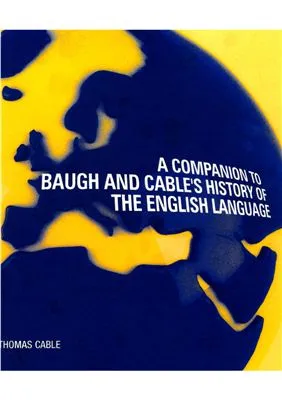
A Companion to Baugh and Cable's History of the English Language History of English linguistics, Historical language development Explore A Companion to Baugh and Cable's History of the English Language for deep insights into English's historical evolution. Analytical
Before you read
“A Companion to Baugh and Cable's History of the English Language” serves as a meticulous guide designed to complement and expand upon the renowned foundational text authored by Albert C. Baugh and Thomas Cable. Written to assist students, academics, and professionals navigating the complex progression of English from its earliest forms to its present-day varieties, this companion facilitates deep engagement with one of the most respected works in the field of historical linguistics.
The companion text systematically bridges gaps, clarifies terminology, and contextualizes historical developments in the English language over more than a millennium. It delves into epochs such as Old English, Middle English, and Early Modern English, tracing the phonological, morphological, and syntactic shifts that have shaped the tongue into what it is today. Instead of replacing the original book, it stands as a scholarly scaffold, providing readers with additional frameworks, timelines, and thematic analyses to enhance comprehension.
For educators, the text offers a highly structured set of pointers to guide discussions, while independent readers gain access to expanded commentary that illuminates areas where historical evidence is nuanced or contested. We also address critical aspects of English’s global spread and its role as a lingua franca in contemporary contexts, forming a connection between linguistic history and current sociolinguistic realities.
This volume distills complex historical knowledge into actionable insight, ensuring that both academic and casual readers grasp the enduring relevance of English's past.
Readers will learn how political, social, and cultural forces have continuously interacted to shape linguistic forms. The companion emphasizes critical junctures—such as the Norman Conquest’s profound lexical influence—alongside the subtler, cumulative shifts in grammar and pronunciation.
A particular strength is its thematic approach: linking periods of language change to broader historical events, philosophical movements, and technological advancements that introduced new vocabulary and affected communication practices.
The following statements capture the intellectual spirit of the work, illustrating its scholarly depth and enduring relevance.
“Language history is not a static record; it is the narrative of human interaction itself.” Unknown
“To understand English is to understand the forces that have shaped its speakers.” Unknown
“Each word carries within it traces of journeys across time and culture.” Unknown
Both seasoned linguists and emerging scholars benefit from a companion volume that focuses intently on illuminating the subtler details of language evolution.
“A Companion to Baugh and Cable's History of the English Language” matters because it guides readers through historical complexities with structured clarity. Many students encounter the original text and find certain sections dense or contextually challenging. This companion acts as a bridge, enriching the reader’s grasp of both major transformations and fine-grained developments.
It also emphasizes historiographical awareness, presenting readers with ways to critically assess differing interpretations of linguistic evidence. Knowing how language has developed—shaped by conquests, migrations, technological shifts, and cultural exchanges—provides not only academic insight but also tools for better understanding contemporary issues in language policy and communication.
“A Companion to Baugh and Cable's History of the English Language” invites readers not merely to absorb information, but to participate actively in the discourse on linguistic evolution.
By revisiting English’s long trajectory—from its ancient Germanic roots to its global modern usage—this companion makes the study of historical linguistics accessible without sacrificing rigor. It encourages collaboration among scholars and dialogue among enthusiasts worldwide.
Whether you are pursuing advanced research, preparing lectures, or simply eager to deepen your appreciation of language history, take the next step: read, reflect, share, and discuss. In doing so, you carry forward the living heritage of the English language, connecting past developments to future possibilities.
Your question is answered in the context of this title and author. Each answer uses 2 points.
0 reviews, 4.6 average out of 5
Sign in to publish a review.
Ask a focused question and learn from the community.
Related references that continue this learning path.
Dennis Freeborn (auth.)