
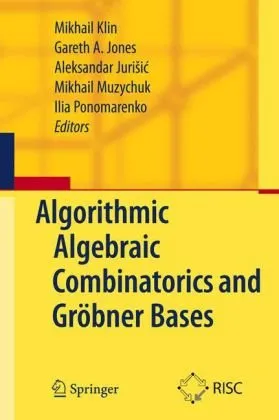
Algorithmic algebraic combinatorics and Grobner bases
Aiso Heinze,Mikhail Klin (auth.),Mikhail Klin,Gareth A. Jones,Aleksandar Jurišić,Mikhail Muzychuk,Ilia Ponomarenko (eds.)
2009
View book
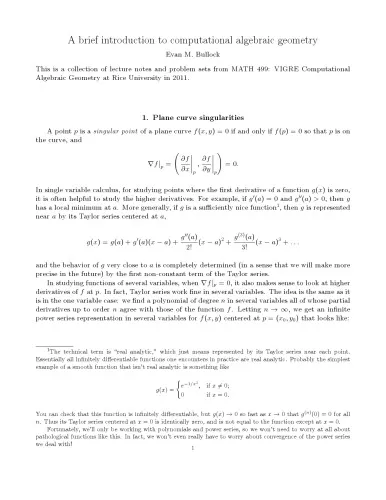
Book guide and evaluation
Evan Merrill Bullock
0 reviews
Published
pages
views
Introduction Welcome to 'A Brief Introduction to Computational Algebraic Geometry' In the modern landscape of mathematics and computer science, computational algebraic geometry has emerged as a potent area of study. This book is crafted to lay down a comprehensive foundation
Before you read
Welcome to 'A Brief Introduction to Computational Algebraic Geometry'
In the modern landscape of mathematics and computer science, computational algebraic geometry has emerged as a potent area of study. This book is crafted to lay down a comprehensive foundation in this field, blending practical computational methods with theoretical foundations. Whether you are a student delving into algebraic geometry for the first time or a seasoned professional looking to enhance your computational prowess, this book offers unparalleled insights and clarity.
A Journey Through the Intersection of Algebra and Computation
'A Brief Introduction to Computational Algebraic Geometry' is divided into meticulously structured chapters, each designed to build upon the last. The narrative begins with an introduction to algebraic geometry's foundational elements, gradually evolving into a discussion on computational methods. This journey navigates through core topics such as polynomial equations, affine and projective varieties, and Grӧbner bases.
One of the significant aspects of this book is its emphasis on applying computational techniques to solve real-world problems. Throughout the pages, you'll encounter various algorithms essential for transforming algebraic problems into computations your computer can handle. We focus on techniques like solving polynomial equations, handling syzygies, and leveraging symbolic computation, all while ensuring clarity through examples and exercises designed to solidify your understanding.
Unlocking the Power of Computational Tools
Words to Inspire and Educate
"The magic of computational algebraic geometry lies not just in computation, but in its ability to transform abstract algebraic ideas into tangible numerical solutions."
"Understanding the language of algebraic geometry opens the door to a universe where every geometric problem can be expressed as a computation."
Transforming Abstract into Practical
Algebraic geometry, in its traditional form, is seen as a domain of pure abstract thought. However, as computational power grows, so does the ability to apply these abstract concepts to complex, real-world problems. This book is vital for bridging the gap between the beauty of algebra and the practicality of computation, making algebraic geometry accessible and applicable for computational scientists, software developers, and mathematicians alike.
In a world where technology and mathematics increasingly overlap, 'A Brief Introduction to Computational Algebraic Geometry' provides essential knowledge to thrive in various fields from cryptography to data science and beyond. By transforming how we view algebraic problem-solving, this book empowers readers to harness computation's full potential, pioneering advancements in science and engineering.
Through structured exploration and a focus on both theory and application, this book successfully nurtures a new generation of thinkers equipped to tackle the challenges of a computational age.
Your question is answered in the context of this title and author. Each answer uses 2 points.
0 reviews, 4.2 average out of 5
Sign in to publish a review.
Ask a focused question and learn from the community.
Related references that continue this learning path.
Aiso Heinze,Mikhail Klin (auth.),Mikhail Klin,Gareth A. Jones,Aleksandar Jurišić,Mikhail Muzychuk,Ilia Ponomarenko (eds.)
Marco Castrillón López,Luis Hernández Encinas,Pedro Martínez Gadea,Mª Eugenia Rosado María (eds.)
Celine Carstensen-Opitz,Benjamin Fine,Anja Moldenhauer,Gerhard Rosenberger