
Book guide and evaluation
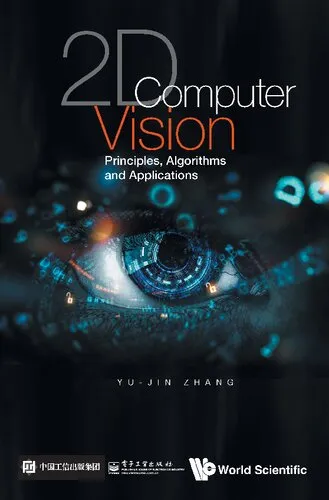
2D Computer Vision: Principles, Algorithms and Applications
Yu-Jin Zhang
English
Beginner
Machine Learning
4.6 / 5
0 reviews
2023
Published
556
pages
246
views
This special compendium introduces the basic principles, typical methods and practical techniques of 2D computer vision. The volume comprehensively covers the introductory content of computer vision and the materials are selected based on courses conducted in the past 20 years.Th
Before you read
What will you get from this book?
This special compendium introduces the basic principles, typical methods and practical techniques of 2D computer vision. The volume comprehensively covers the introductory content of computer vision and the materials are selected based on courses conducted in the past 20 years.The useful textbook provides numerous examples and self-test questions (including hints and answers) through intuitive explanations to help readers understand abstract concepts.This unique reference text provides the first computer vision course service for undergraduates of related majors in university and colleges. It also allows teachers to carry out online courses and strengthen teacher-student interaction when teaching.
This book is a special textbook that introduces the basic principles, typical methods, and practical techniques of 2D computer vision. It can serve as the first computer vision course material for undergraduates of related majors in university and higher-engineering colleges, and then they can study “3D Computer Vision: Principle, Algorithm, and Applications”.
This book mainly covers the introductory content of computer vision from a selection of materials. This book is mainly for information majors but also useful for learners with different professional backgrounds. This book is self-contained in contents and also considers the needs of self-study readers. Readers can not only solve some specific problems in practical applications but also lay a foundation for further study and research on high-level computer vision technology.
This book generally considers the following three aspects from the knowledge requirements of the prerequisite courses: (i) mathematics, including linear algebra and matrix theory, as well as basic knowledge of statistics, probability theory, and random modeling; (ii) computer science, including the mastery of computer software technology, understanding of computer structure system, and application of computer programming methods; (iii) electronics, including on the one hand, the characteristics and principles of electronic equipment, and on the other hand, circuit design and other content. In addition, it is best to study this book after finishing the course on signal processing.
Ask this book
Your question is answered in the context of this title and author. Each answer uses 2 points.
Sign in to ask the book assistant.
Reader reviews
0 reviews, 4.6 average out of 5
No reviews yet
If you have read this book, help the next reader with your experience.
Write a review
Sign in to publish a review.
Reader questions and answers
Ask a focused question and learn from the community.
Sign in to ask or answer a question.
No questions yet
Be the first to ask a clear, useful question.
What to read next
Related references that continue this learning path.
Instructor’s Manual: Exercise Solutions for Artificial Intelligence A Modern Approach - Third Edition
Stuart J. RussellandPeter Norvig
2010
View book
Distributed Artificial Intelligence: A Modern Approach
Satya Prakash Yadav (editor),Dharmendra Prasad Mahato (editor),Nguyen Thi Dieu Linh (editor)
2021
View book